
Nahttypen: A Complete Guide to Seam Types
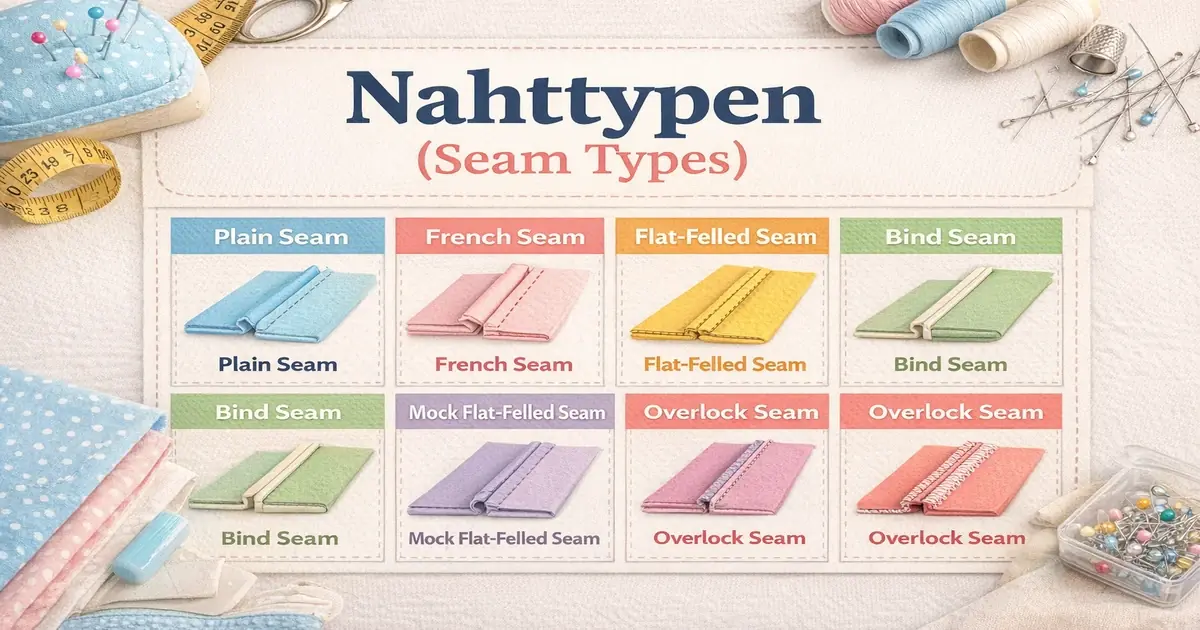
If you sew clothing, home textiles, or fabric products, understanding nahttypen (seam types) is one of the most important sewing skills. The seam you choose affects how strong a garment is, how it moves, how long it lasts, and how professional it looks.
However, beginners often feel confused because different fabrics and garment areas need different seam constructions. Therefore, learning how nahttypen work will immediately improve your sewing results.
What Are Nahttypen?
In sewing and garment construction, nahttypen describe the way two or more fabric pieces are joined together with stitches.
A seam is the connection between fabric layers.
A stitch is the thread pattern that holds them together.
Choosing the right nahttyp matters because it influences:
- seam strength
- stretch and movement
- fraying resistance
- comfort and drape
- durability after washing
So, seam selection is both a technical and design decision.
Common Nahttypen Explained
Plain Seam (Steppnaht)
The plain seam (Steppnaht) is the most basic and widely used seam. Two fabric pieces are placed right sides together and stitched along the seam line. The seam allowances remain inside the garment.
Common uses:
shirts, dresses, pillow covers, curtains
Advantages:
- easy for beginners
- quick to sew
- works with most fabrics
Limitations:
- raw edges can fray
- moderate strength
Therefore, plain seams are often finished with zigzag stitching or overlocking to prevent fraying.
French Seam (Französische Naht)
A French seam (Französische Naht) encloses the raw fabric edges inside the seam. This creates a clean interior and prevents fraying.
Common uses:
silk blouses, chiffon dresses, delicate garments
Advantages:
- no visible raw edges
- elegant finish
- good for lightweight fabrics
Limitations:
- not suitable for thick fabrics
- slightly more sewing steps
As a result, French seams are popular in fine garment sewing.
Flat-Felled Seam (Kappnaht)
The flat-felled seam (Kappnaht) folds and stitches seam allowances flat. This creates a very strong and durable seam with no exposed edges.
Common uses:
jeans, trousers, workwear, outdoor clothing
Advantages:
- very strong
- highly durable
- neat interior and exterior
Limitations:
- more complex to sew
- requires precise trimming
Because of its layered structure, this seam is ideal for high-stress areas.
Overlock Seam (Overlocknaht)
An overlock seam (Overlocknaht) is sewn with a serger machine that trims and stitches the edge at the same time. It is essential for stretch fabrics.
Common uses:
T-shirts, knitwear, sportswear, underwear
Advantages:
- stretches with fabric
- prevents fraying
- fast sewing
Limitations:
- less structured
- requires serger machine
Therefore, overlock seams are standard in knit garment construction.
Blind Hem Seam (Blindstichnaht)
The blind hem seam (Blindstichnaht) attaches a hem so that stitches are almost invisible from the outside.
Common uses:
trousers, skirts, dresses, formal garments
Advantages:
- invisible finish
- professional appearance
- clean hem
Limitations:
- moderate strength
- needs careful alignment
This seam is widely used in tailoring.
Nahttypen Comparison Chart
| Nahttyp | Strength | Stretch | Best Fabric | Visibility | Difficulty | Typical Use |
|---|---|---|---|---|---|---|
| Plain seam | Medium | Low | Cotton | Visible | Easy | shirts |
| French seam | Medium | Low | Silk | Hidden | Medium | blouses |
| Flat-felled | High | Low | Denim | Visible | Hard | jeans |
| Overlock | Medium | High | Knit | Edge | Easy | activewear |
| Blind hem | Low | Low | Woven | Invisible | Medium | hems |
Which Nahttyp for Which Fabric?
Fabric type strongly influences seam choice.
Lightweight fabrics (silk, chiffon):
French seam prevents fraying and looks delicate.
Medium fabrics (cotton, linen):
Plain seam or French seam works well.
Heavy fabrics (denim, canvas):
Flat-felled seam provides durability.
Stretch fabrics (jersey, knit):
Overlock seam allows movement.
Thus, always match seam behavior to fabric properties.
Nahttypen by Garment Area
Different garment areas experience different stress levels.
- side seams → plain or overlock
- crotch seams → flat-felled
- hems → blind hem
- shoulders → reinforced plain
- activewear seams → overlock
So, seam placement should consider movement and load.
Industrial Nahttypen Classes (ISO Overview)
In industrial garment production, seams are classified into standard seam classes such as:
- superimposed seams
- lapped seams
- flat seams
- bound seams
Industrial machines control stitch density and tension precisely. Therefore, factory seams are often stronger and more consistent than home-sewn seams.
Common Nahttypen Mistakes and How to Avoid Them
Seam puckering:
Occurs when tension or feed is uneven. Adjust stitch length and tension.
Fabric fraying:
Happens with unfinished edges. Use French or overlock seams.
Weak seams:
Caused by wrong seam choice. Use flat-felled in stress areas.
Uneven seam allowance:
Results from poor guiding. Mark seam lines before sewing.
Pro Tips for Choosing the Right Nahttyp
- match seam to fabric thickness
- consider stretch and movement
- balance strength and appearance
- test seam on scrap fabric
Experienced sewers always test before final sewing.
Conclusion – Choosing the Right Nahttyp for Any Sewing Project
Understanding nahttypen helps you select seams that match fabric, garment function, and durability needs. While beginners often start with plain seams, advanced sewing uses specialized seams such as French, flat-felled, and overlock for better performance and finish.
Ultimately, choosing the correct seam improves garment quality, comfort, and longevity.
Frequently Asked Questions
What is the strongest nahttyp?
Flat-felled seam (Kappnaht).
Which nahttyp is best for stretch fabric?
Overlock seam.
Which nahttyp is used for jeans?
Flat-felled seam.
Difference between Steppnaht and Kappnaht?
Steppnaht joins fabric; Kappnaht reinforces and encloses edges.
Which nahttyp prevents fraying?
French seam or overlock seam.
Best nahttyp for beginners?
Plain seam (Steppnaht).