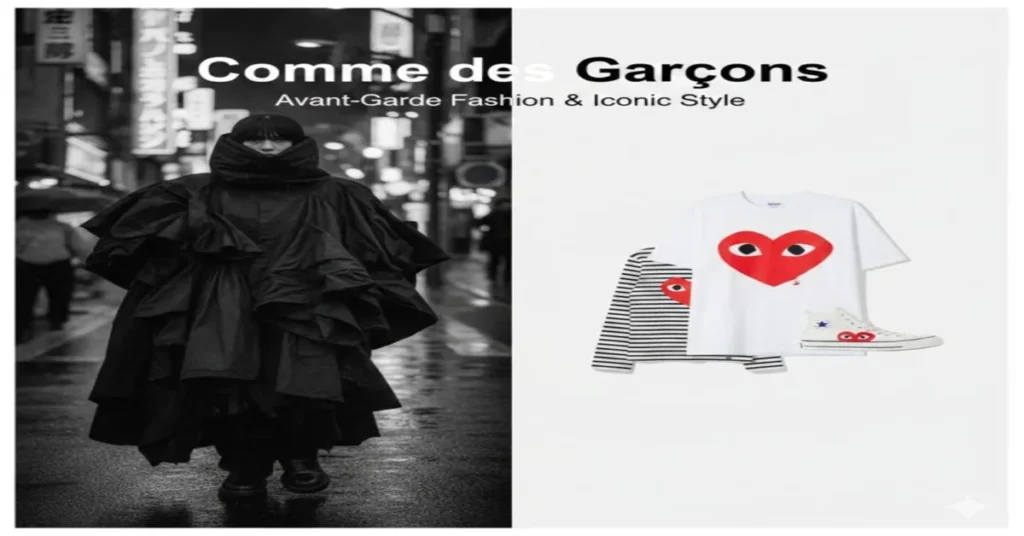
If there’s one label that has consistently pushed the envelope, advanced conversation and altogether redefined fashion, it’s Comme Des Garçons. This Japanese powerhouse, which started up in 1969, is way more than a clothing label — it’s philosophy writ large with cloth and contour. The name, which is French and means “Like the Boys,” at that point hinted at an early interest in androgyny and a refusal of traditional femininity.
Who is the Visionary Behind Comme des Garçons
It is Rei Kawakubo, the inscrutable founder of Comme des Garçons, who embodies all that obstinate spirit.
The Tokyo-born visionary Kawakubo began with no formal study of fashion design. She studied art history and literature in college, a study that still imbues her designs, which she sees as an intellectual and artistic canvas.
-
Her design philosophy is rooted in concepts that challenge Western fashion norms.
-
She views her company as an engine for creation, with clothes serving as one output.
-
She famously avoids sketching, preferring to work through words, imagination, and a relentless pursuit of the “new.”
She is not trying to make clothes that are conventionally pretty or flattering. Rather, she designs clothes that challenge and ultimately overturn prevailing notions of the body, gender and social taste.
The Radical Debut: Deconstruction and the Color Black
When it debuted in Paris in 1981, it sent shockwaves through the fashion establishment.
Critics were accustomed to the glamorous, figure-hugging silhouettes of Parisian couture. Kawakubo presented something radically different:
-
Deconstructed garments with raw, unfinished hems.
-
Layered, oversized, and often asymmetrical silhouettes.
-
A somber, monochromatic palette—predominantly black.
This look was quickly—and often negatively—dubbed “Hiroshima chic” or the “ragpicker look.” Yet, this initial controversy cemented the brand’s position as an avant-garde leader. It introduced Japanese aesthetic principles like wabi-sabi (finding beauty in imperfection) and mu (emptiness/void) to the global stage.
Unraveling the Comme des Garçons Universe
The success of the brand is in its complexity. Comme des Garçons is an umbrella for moire than two dozen separate diffusion lines and creative projects. Each sub-caption has its personal vibe to conform with the different market groups, so that the brand can offer that high-fashion-edge collection not only to “cool” girls but also to mums.
This stratified organization is part of Kawakubo’s genius, enabling the arch artistic vision to be palpable alongside commercial success.
The Ubiquitous Play Line
Perhaps the most recognizable and commercially popular line is Comme des Garçons Play.
-
Launch: 2002.
-
Aesthetic: Simple, casual basics like T-shirts, knitwear, and hoodies.
-
The Logo: It is instantly identifiable by the iconic red heart with two eyes, designed by New York artist Filip Pagowski.
The CDG Play range is a great starting point for those new to the label. It is a symbol, a feeling — not so much an especially profound design concept as merely giving us a piece of the Comme des Garçons ethos without asking you to pay many thousands of avant-garde dollars for it.
The Mainline Collections
The mainline collections—specifically Comme des Garçons and Comme des Garçons Homme Plus (menswear)—are the true heart of the brand’s artistic expression.
These are the pieces seen on the runways that challenge our very understanding of clothing:
-
The 1997 “Lumps and Bumps” collection featured garments with internal padding that distorted the body’s natural form.
-
They often feature unexpected fabrics, extreme volumes, and highly conceptual, sculptural shapes.
-
Kawakubo’s runway shows are renowned for being less about clothes and more about living, wearable art installations.
Notable Sub-Labels and the CDG Shirt
Other important diffusion lines further explore specific facets of the brand’s philosophy:
-
CDG Shirt: This line focuses on reimagining the foundational garment of the men’s wardrobe, adding patchwork, bold prints, and asymmetrical cuts.
-
Comme des Garçons BLACK: Launched during the 2008 recession, this line offered more accessible and foundational black pieces, eventually becoming a permanent, popular staple.
-
Junya Watanabe Comme des Garçons: Headed by Kawakubo’s protégé, this line is known for sophisticated but experimental construction, often blending traditional tailoring with technical materials.
High-Impact Collaborations and Influence
It has nailed the art of collaboration, aligning itself with mass-market brands to bring its non-conformist spirit to masses. These partnerships usually become instant, highly-coveted streetwear forevers.
You May Also Like It : Drape Dress
The Iconic CDG Converse Partnership
The collaboration between Comme des Garçons Play and Converse is arguably one of the most successful and enduring in fashion history.
-
The classic Chuck Taylor All Star and Chuck 70 silhouettes are simply adorned with the recognizable heart logo.
-
The sneakers bridge the gap between high fashion and everyday, casual footwear.
-
They offer a subtle, stylish statement that remains relevant year after year.
CDG and Nike: Reimagining the Sneaker
Its partnerships with Nike, the brand’s projects are frequently more experimental, reflecting Kawakubo’s penchant for subversion. They’ve experimented with nontraditional silhouettes and put avant-garde touches on classics.
Past projects include:
-
Re-imagining the Air Force 1 with playful, three-dimensional elements.
-
Giving the Nike Shox silhouette exaggerated, avant-garde details.
These releases emphasize that Comme des Garçons sees sportswear as another canvas for innovation and deconstruction.
What is Dover Street Market
A second tent pole in the Comme des Garçons empire is Dover Street Market (DSM). It was an avant-garde, multi-brand retail concept inaugurated by Kawakubo and her husband, Adrian Joffe.
DSM is not a traditional department store.
-
It is an experiential retail space described as “beautiful chaos.”
-
It houses all Comme des Garçons lines alongside a curated mix of other high-fashion, streetwear, and emerging brands.
-
The store interiors are continuously overhauled and feature artistic installations, embodying the spirit of creation over commercialism.
It was founded in London in 2004, and has since expanded to both New York and Los Angeles, as well as Tokyo. Dover Street Market has evolved into a mecca for fashion fans, and is proof of the brand’s devotion to unusual retail.
The Enduring Legacy of Comme des Garçons
For over fifty years, Comme des Garçons has consistently refused to follow trends. It creates its own path, offering a powerful alternative to the mainstream fashion cycle.
The brand’s influence stretches far beyond the runway:
-
It paved the way for other conceptual designers by prioritizing ideas and artistic expression over conventional commercial viability.
-
It helped popularize the use of black in fashion as a color of intellectualism and sophistication, rather than just mourning.
-
The brand’s deconstructed aesthetic and oversized silhouettes have seeped into contemporary streetwear and luxury design globally.
The unswerving vision to “make something new” that propels Rei Kawakubo also propels the entire Comme des Garçons enterprise. It’s a world that sees’ clothing as communicative, challenging and serves as an object to express individuality and freedom. That Comme des Garçons manages to surprise, provoke and delight is not just a testament to the powers of Kawakubo personally but also one that, nonetheless since 1973, implicates you.
You May Also Like It : Blazertje